Back from China: Two Cosmologies, Two AIs, and One Social Soil

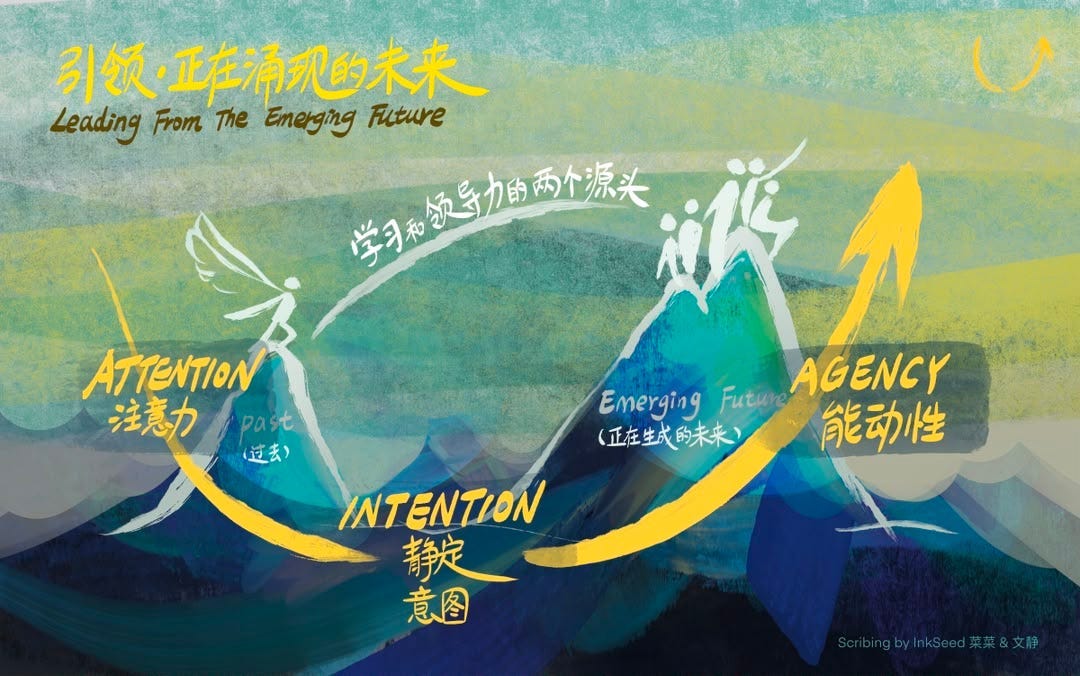
I just returned from my first China trip since 2019. Having worked regularly with multiple groups, organizations, and initiatives in China during the 2012–2019 period — via the MIT IDEAS China program and also sparked by my MIT u-lab class, which, via edX and Tsinghua University, has been made accessible in China — these connections have been limited to mostly online engagements ever since the pandemic.
Returning now makes me realize that this journey touched me on a deeper level. Reconnecting with many old colleagues and friends, as well as meeting new ones, made me feel, at least for a moment, a bit less fractured by the nonsensical geopolitical othering that keeps running our world politics these days, and that broke my heart already many years ago. With the term geopolitical othering I refer to a foreign policy that is organized around a worldview with a clear divide: in the center is US as the chosen country, and then, with concentric circles around that center, THEM: first the allies, then the non-aligned, and finally, in the outermost circle, the axis of evil. While the countries that populate the axis of evil sphere change over time, the underlying structure doesn’t.
My point is: This worldview is no longer fit for the 21st-century realities we are facing now. Because it continues to generate results that nobody wants: senseless wars, a reckless AI arms race, and an inaction towards our climate chaos that amounts to organized irresponsibility (to use Ulrich Beck’s term).
The following eight observations are my attempt to make sense of what touched me during a trip that took me to the frontlines of pioneering a new philanthropic sector, of reimagining schools and universities in the face of AI, as well as of business and community-based regeneration through the methods and tools of awareness-based systems change.*1
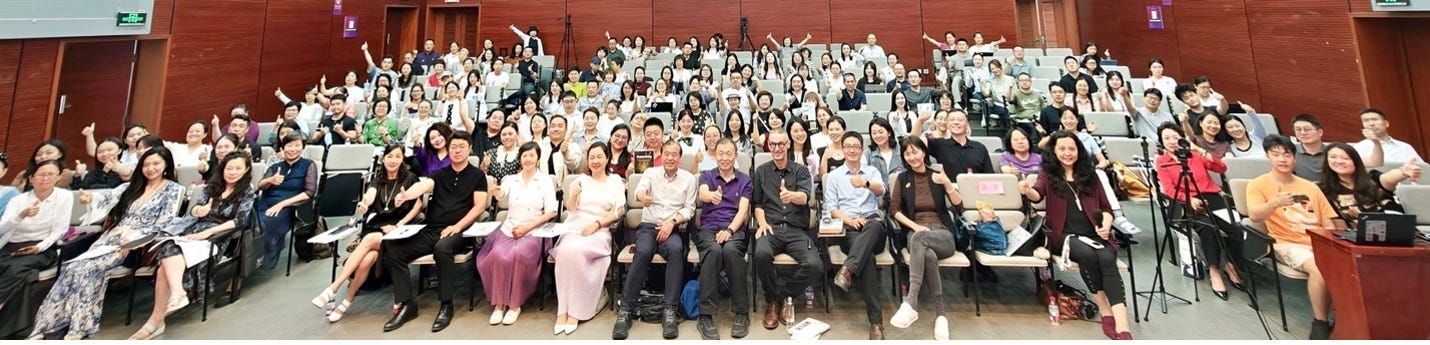

1. China and the US: Two AI Strategies as Expression of their Cosmologies
This trip made me realize that the two approaches we currently see regarding AI each embody a different underlying cosmology. Cosmologies are for civilizations what worldviews are for individuals. The dominant Western cosmology is essentially based on a transcendent concept of the divine (monotheism), and a linear notion of time that has a clear beginning and an end. The Chinese cosmology, by contrast, is based on an immanent conceptualization of the divine and a more cyclical concept of time, without a clear beginning and end. This fork is not new: during the first Axial Age we saw in Greece and Israel people responding to the crisis of their era through transcendence, and in China through immanence (for more detail, see my recent Noema essay).
Twenty-five centuries later, the same fork reappears now in our assumptions that shape today’s two main AI narratives. In the West, we see the race to AGI as the creation of a single God-like entity — the story that animates our entire AI bubble and its multi-trillion-dollar investment hype. In China, we see more skepticism toward AGI, and much more focus on real-world applications that help people, especially underserved communities, gain better access to educational, health, agricultural, and medical services.
The same fork also shows up in the architecture of the models themselves: America’s frontier systems are closed and proprietary, while China’s leading models are open-weight — published for anyone to download, adapt, and build on. This is why they are now spreading rapidly across the Global South, as Nathan Gardels, drawing on the AI pioneer Andrew Ng, pointed out in Noema just days ago. The paradox of our moment is that the more closed society is winning the world with open models, while the more open society puts all its focus on advancing closed models.
This difference also explains in part why the backlash against AI is so much less developed in China — where people tend to experience AI as a tool that benefits at least most of them — than in the US, where the dominant AI story threatens to take everything from people — jobs, income, meaning — while concentrating the benefits in a tiny group of techno-feudal empire builders.
2. The Race to the Last Day: AGI and the Transcendent Current
The race to AGI and to artificial superintelligence that transfixes Silicon Valley these days is built on a set of deep assumptions that reflect the Western cosmology in every single way. It is a view that sees history as a journey toward a final event (of judgment in its biblical, and of singularity, in its AI version), arriving from beyond the human, which then is redeeming or destroying us. Silicon Valley did not invent this story; it inherited it.
Philosophers like Karl Löwith argued already decades ago that the modern idea of progress can be seen as a secularized biblical story of the last things, translated into the language of history. The race to AGI embodies and completes that interpretation: the Last Day, rebuilt in a datacenter, and enabled by a cathedral of compute. Transhumanism makes that link explicit. In Ray Kurzweil’s singularity, the classical religious motifs all return in technological costume: transcendence of the body (uploading), immortality (life extension as an engineering problem), even resurrection (the digital reconstruction of the dead). The anthropology underneath amounts to a view of the human as machine, mind as software running on inferior hardware, waiting for its upgrade.
What this worldview cannot imagine is that death, finitude, and embodiment are not bugs to be engineered away but the very conditions of being human, of our inner development and growth. The real frontier is not the numbing of interiority, but its deepening.
Transhumanism reaches for vertical integration through exteriorization, i.e., through the machine: the vertical axis rebuilt in silicon because it was never cultivated within the human self. The result of this cosmology is a public AI discourse that oscillates between techno utopia and doom, the two principal options in the context of the Last Day.
During my week in China — from Tsinghua to NICE — this entire discourse was simply absent from every AI conversation I was part of. Not suppressed: absent.
3. China’s AI as Immanent Pragmatism: The Cyclical Current
In China, by contrast, we encounter an understanding of time and history that knows no Last Day and no finish line. In a cosmology without an end of history, there is nothing to race toward — only a field or ecosystem to harmonize, season after season.
Which is why, in this frame, technology holds no license to transcend and upend the social order; it must be absorbed into the existing societal fabric, or, as we saw in the recent crackdown against powerful private platform companies, it may be illegitimate. Chinese examples such as executives preferring a slower AI rollout over an AI backlash, or a court ruling that companies may not lay off workers just to replace them with AI, or the ban on AI companions for minors, can all be read as an expression of the underlying cosmology.
The applications built on the open-weight models point in the same direction: intelligence diffused downward to society’s soil rather than concentrated upward into the temple — AI diagnosticians for villages that have no doctors, AI tutors for schools that have no qualified teachers, precision tools for smallholder farmers.
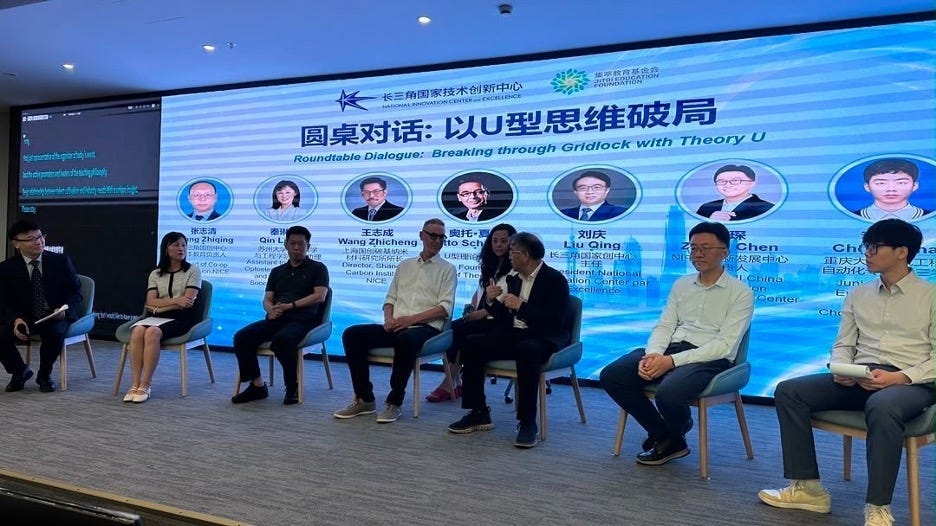
I saw a striking institutional expression of this on the last day of my trip, at NICE, the National Innovation Center for Excellence in the Yangtze Delta — one of China’s leading ecosystems for weaving universities, tech innovators, and business ecosystems in the age of AI. Its director is currently forming a new international university built on a co-op model: intense periods on campus alternating with equally intense deep dives into organizational work and practice. The challenge that he is facing is quite similar to what we see in societies around the world: a disconnect between what companies need and what universities do — a disconnect that AI, and the collective sense of depression many (especially younger) people share, continues to deepen. In the face of that challenge, I found his hands-on response, to simply build a new international university in partnership with other universities embodying a new set of principles and practices, a refreshing strategy that is open to the interior dimension in ways I did not expect.
The next two observations take a deeper dive into the various shadow aspects for each of the two cosmologies: transcendent and immanent.
4. The Shadow of the Transcendent Path: A New Priesthood and Techno-Feudalism
The transcendent path, if unbalanced, casts a shadow that is already visible today. The closed model recreates the oldest institution of the transcendent age: access to the highest intelligence, mediated by a priesthood, on its own terms, and against a (subscription) fee. The storyline of this path can be told in three verbs: create it, own it, and escape.
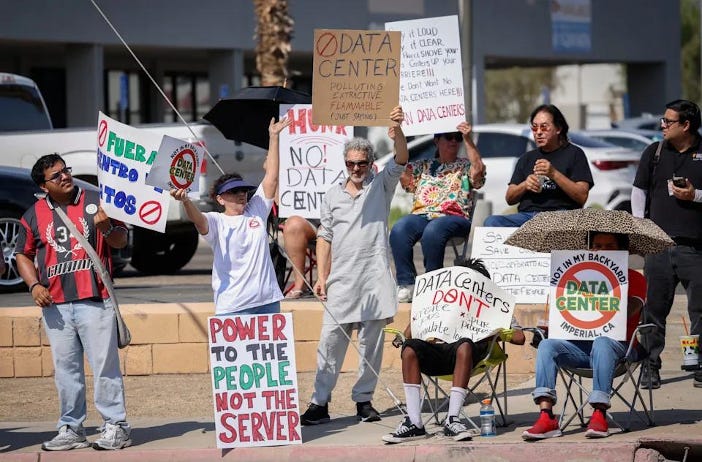
Create the God-like superintelligence. Here, the focus is on creating the cathedrals of compute, fed by rivers and power grids, in the service of creating an intelligence that is God-like (omniscient, omnipotent, and omnipresent ) even though it is not necessarily benevolent. This means that land, water, and energy are consumed at a massive scale: Burning the earth to reach heaven. It is no coincidence that communities across the US are fighting datacenter construction: our social fabric tears at exactly the points where the distributed temple structure is being built.
Own the God-like intelligence. While the many work for data-generation, data-harvest, and data-cultivation, only the very, very few own the estate. Even though the models have been trained on humanity’s shared knowledge, the returns only flow into the narrowest concentration of wealth and power we have ever seen in economic history.
Bunker and Escape. The third verb is about the bunker, the rocket, and the upload. In short: salvation for the few, and tribulation for the rest. A civilization whose elites are preparing their own exit from the planet, from the body, or from mortality, is a civilization that has stopped believing in its own soil.
What is the shadow of the transcendent path? Creating a God-like intelligence, owning it, and then retreating into a bunker-and-escape doomsday mindset, all of which results in deepening our ecological, social, and spiritual divides. In short: the essence of this shadow is about an intelligence and transcendence without interiority.
5. The Shadow of the Immanent Path: Total Systems Management and Control
The immanent path, taken to the other extreme, also casts its own shadow. If the pattern is entirely within the world, why not manage it completely? On this path, each of the immanent tradition’s genuine virtues, such as attentiveness to the whole, caring for balance, stewarding the collective, gets turned, by just one degree, into its shadow form: seeing becomes surveillance. Holding and harmonizing becomes administering. Stewarding becomes steering. Caring becomes control.
The result is a total systems management that is omniscient, omnipotent, and omnipresent, but that lacks interiority: the social field as managing a set of behaviors rather than as co-sensing and co-shaping what wants to emerge. Every citizen is visible to the cameras — but visibility is not the same as being seen. I have learned about this issue, the lack of empathy and warmth, also from other public-sector servants in SEA who work inside some of the most digitally advanced governments.
The same shadow also shows up geopolitically. Dominance by diffusion is still dominance. Global pre-eminence in all essential future tech industries can turn into an obstacle. Because economic relationships that are built on unilateral dominance by one side do not generate friendship and partnership, they generate dependence and resentment. That, in short, is the other shadow: immanence and intelligence without interiority.
6. The Shared Blind Spot — and Its Healing: Regenerating the Social Soil
Which brings us to the deepest layer. The shadow of transcendence and the shadow of immanence both exhibit the issue of unilateral dominance — one more militarily, and the other more economically. In both cases, they lack the same thing — a deeper understanding of reciprocity and of cultivating the social soil, i.e., of the deeper relational dynamics from which all civilizations and societies grow.
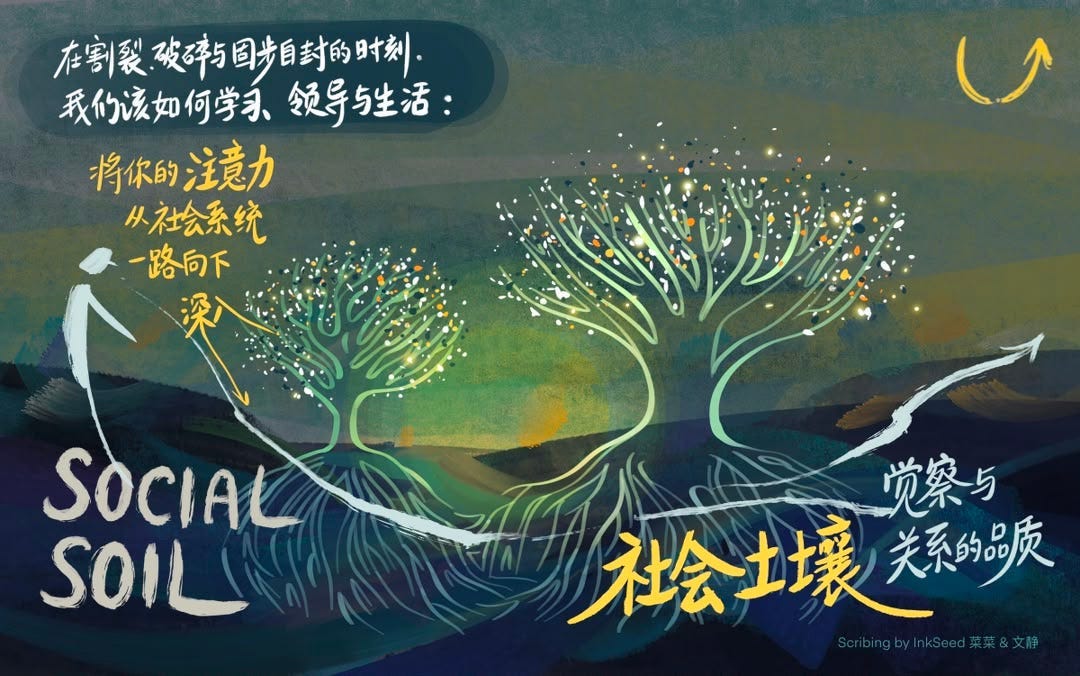
Figure 1 depicts the concept of social soil, the deeper root system of the social field, as the quality of our awareness and relationships.
Building on that, figure 2 differentiates four different qualities of relationship and types of collective action:
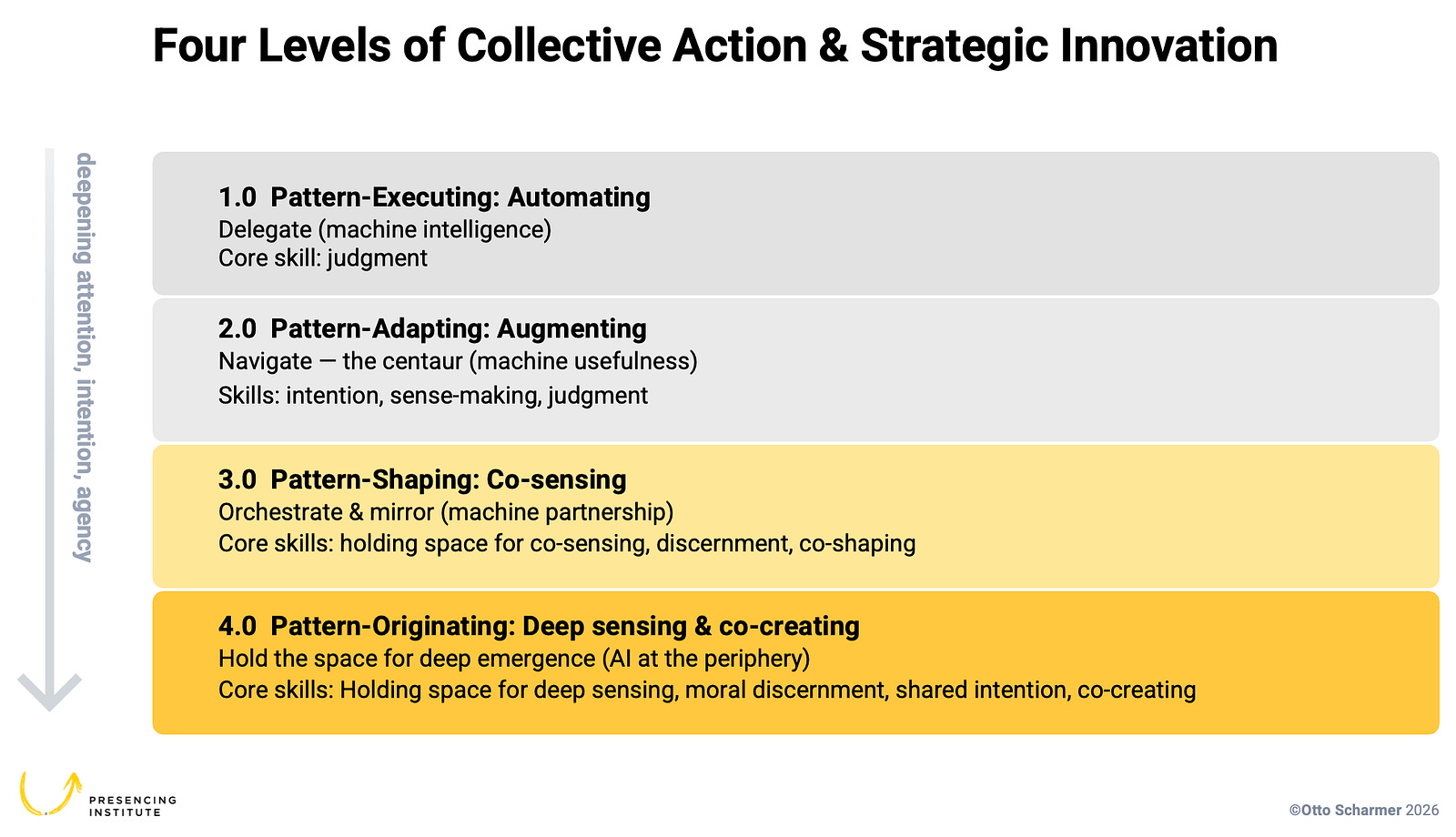
Both of the current AI strategies discussed above are good at pattern-execution and pattern-adaptation (levels 1 and 2). And both of them tend to hit their limits when it comes to pattern-sensing and pattern-originating (levels 3 and 4, figure 2).
The most important leadership work of our time, and the reimagination of our institutions of learning, is about holding all four levels in balance — which under our current conditions means to center more around levels 3 and 4.
In practice, this implies re-balancing the use of artificial intelligence (AI), as an amazing yet structurally backward looking intelligence (as it is trained on the data of the past), with organic intelligence (OI), that tunes into the embodied co-existence and co-evolution of different living systems that are structurally coupled in shared ecosystems, with source intelligence (SI), the intelligence of the whole field, which centers around the soil from which all perspectives and possibilities grow (for more detail: my recent SMR article on that topic).
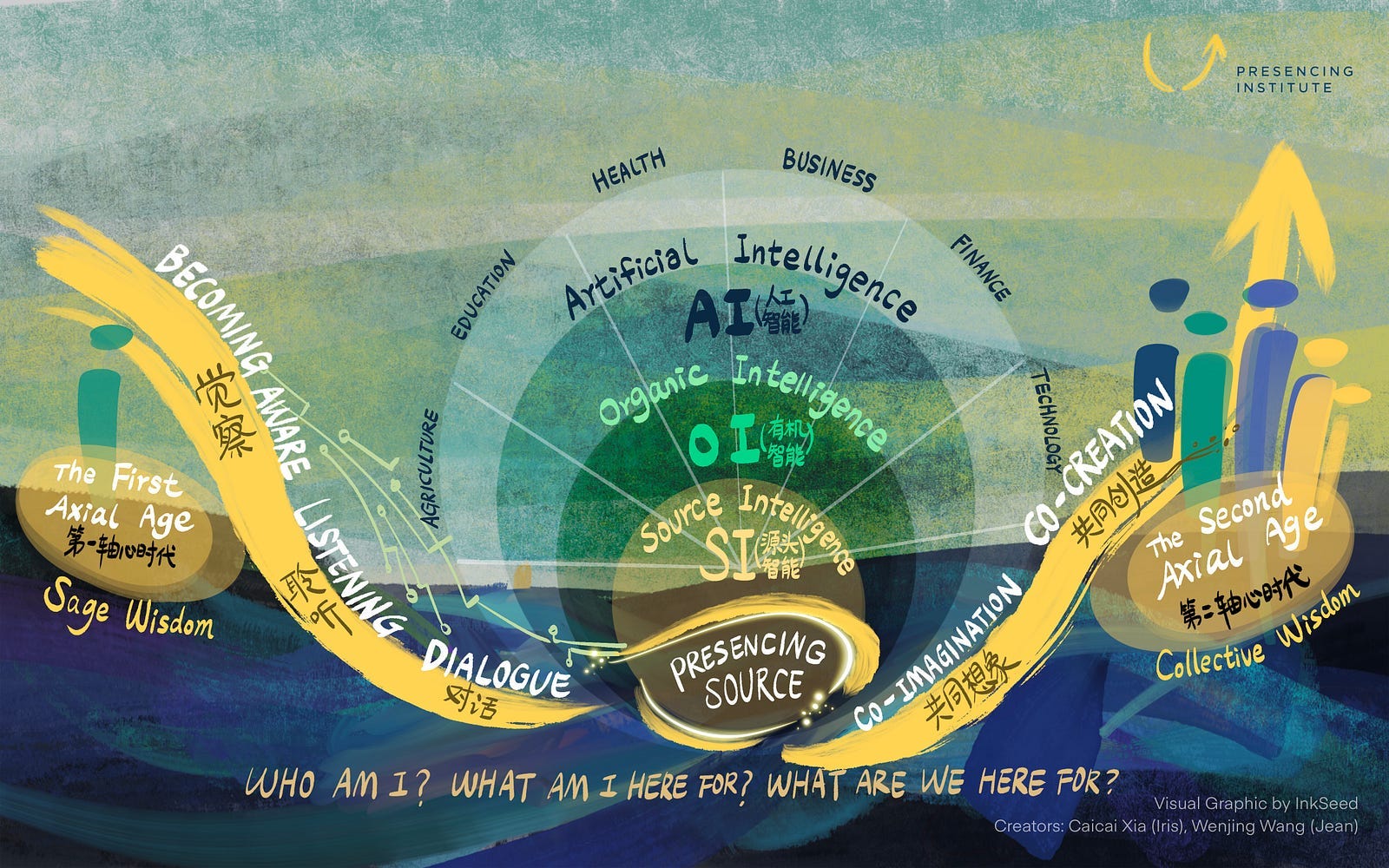
Cultivating that deeper soil means attending to the interior conditions — the quality of shared attention, of relationship, of co-sensing — as the ground from which any intelligence arises.
Artificial intelligence can be engineered. Organic Intelligence can be supported. But the Source intelligence of the social field can only be cultivated and grown.
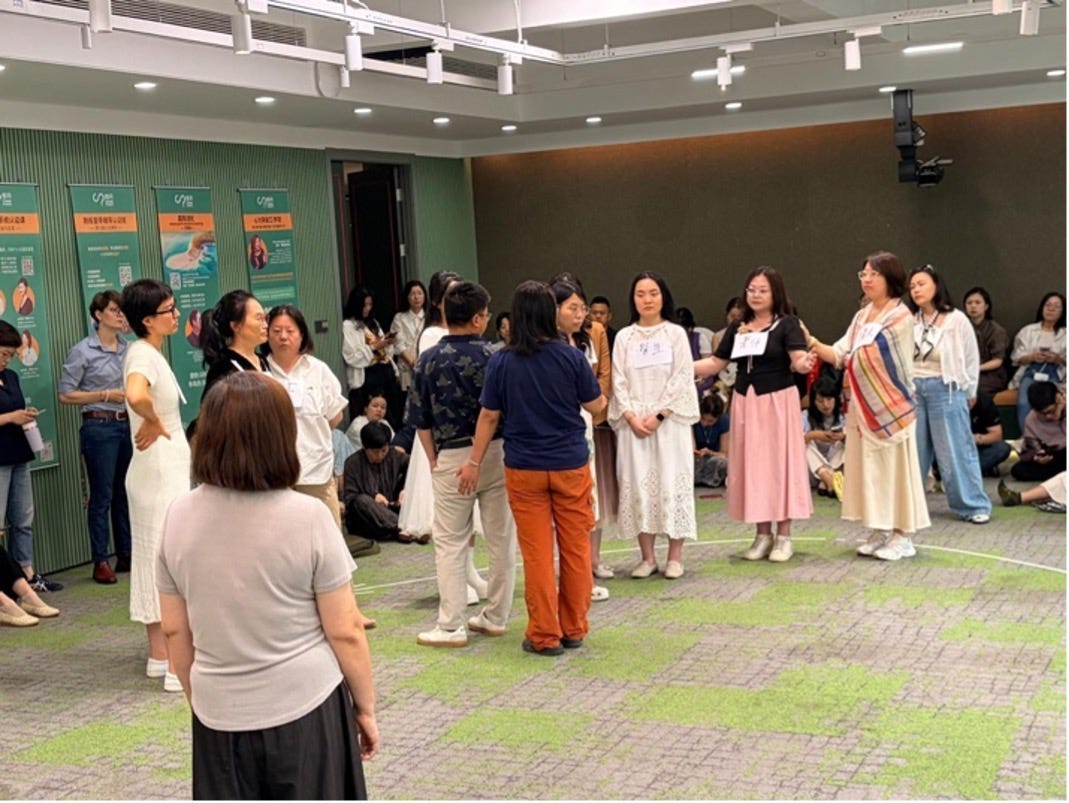
On the last morning of the trip, at the CCCoaching center in Shanghai, we ran a 4D mapping practice on the future of universities and learning (4D is a mapping that makes visible the deep structures of both current reality and the emerging future of a system). In the sculpture that emerged, a woman represented the role of students (fourth person from right, in white). Just before she spoke, the person standing beside her — representing faculty — declared that the primary concern of all faculty is to serve their students. The student’s response: “I never felt any of that. Nothing.”
And at the front stood a person representing our planet (Mother Earth). She said: “I carry all and each of you in my heart.” Yet, nobody was paying any attention to her. Nobody. That, in one image, is the condition in many of our institutions today — in cities and capitals across the globe.
7. A Root Issue: The Geopolitics of Othering
We live in a time that can be described as another axial threshold (see my recent Noema essay). It’s a time that calls on us to shift our awareness from silo to systems, from ego-system awareness to eco-system awareness, to collaborate across all boundaries.
And what are we doing instead? Geopolitical othering. We see a collective behavior that amplifies and deepens all three existential threats that humanity faces in this century — nuclear war, ungoverned AI, and ecological collapse. In January, the Bulletin of the Atomic Scientists set the Doomsday Clock at 85 seconds to midnight, the closest to catastrophe in its 79-year history, citing precisely this triad.
As an American, I can say that for the past 25-plus years, we have seen the same failed strategy of geopolitical othering, expressed by a TINA logic (“there is no alternative”) style of thought, which has exacerbated all three of these issues. While this is a global pattern, we have seen this mindset especially shaping US foreign policy of the past 25-plus years.
It has resulted in an increasing number of forever wars that make everyone lose except, of course, the growing military-industrial complex; an AI arms race now fueled by the same logic; both of which keep draining the resources urgently needed to address our increasing climate chaos, thereby amplifying that issue too.
Judged by its own criteria — has it produced security? — this strategy has produced the exact opposite: endless wars, a geopolitical fracture, and the destruction of trust internationally, not to mention the torn social fabric at home.
Yet, a strategy that manufactures the enemies and issues it is supposed to address is not a strategy. It is just an outdated pattern-executing machine (levels 1 and 2) — a 19th-century mindset running on a 21st-century planet.
In our current world, the mutual othering machine has no winner, only a shared descent. The supposed rivalry is the symptom; the outdated operating system is the unspoken problem to be addressed.
8. From ‘Winning’ to Weaving: Three Core Points for Cultivating Social Soil
Which brings us to the question of how. How do we rebuild the social soil? How do we move forward?
In their recent New York Times essay, written after their own June visit to China, Eric Schmidt and Selina Xu concluded that the real challenge is not which superpower wins the AI race, but whether either one can realize AI’s benefits without ripping apart its social fabric. They proposed a “populist AI agenda” in response. I want to build on that and extend it.
Here are three key ideas, each on a different level of social, economic, and cultural complexity.
(1) Share the gains. Treat AI profits as a commons. The models are trained on our shared knowledge, so the returns should flow back to all. A sovereign fund that distributes them (think of Singapore’s Temasek, the Alaska Permanent Fund, or Australia’s Future Fund) is a great starting point for generating prosperity for all: necessary, but not sufficient.
(2) Open the means. Open-weight and public-interest models as public innovation infrastructure: we need all communities to be able to build, inspect, and adapt the tools that increasingly run their lives — which could, if connected with a new social contract, realign AI with human and planetary wellbeing.
(3) Regenerate the soil. We need a massive investment in social soil — a deep sensing infrastructure built at the same level of ambition that we currently use to build compute infrastructure. What NASA was to space, and CERN was to matter, we now need as an intentional enabling infrastructure for regenerating the social soil.
These three elements, if embodied together, could be critical in shifting our evolutionary trajectory from self-destruction to flourishing. The first two ideas have already entered the discussion in some ways, as the op-ed by Schmidt and Xu demonstrates. But without the third one, many of the good intentions regarding the first two may end up being ineffective or non-transformative.
At the core of the regenerate-the-soil idea is a shift from an old mindset of extraction and unilateral dominance to a more polycentric and plurilateral architecture of collaboration and governance. One planet, one atmosphere, one social soil. From winning to weaving, from conquering to cultivating our shared future field. From either transcendent or immanent to both-and.
Do historical examples of regenerating the soil exist? They do. When Denmark hit rock bottom in the nineteenth century — a bankrupt state, lost wars, lost territory, a rural population left behind by the currents of modernization — the response that mattered most did not come from the government. It came from an educational innovation inspired by N.F.S. Grundtvig: the folk high schools. Residential schools for ordinary farmers and workers, with no exams, no grades, and no degrees, built instead on what Grundtvig called the living word: dialogue, song, story, and the encounter between people who would otherwise never meet. Their purpose was not workforce training but the awakening of the human spirit: education for life, not for a diploma. Within two or so generations, this mostly invisible infrastructure had helped transform a defeated agrarian society into one of the most democratic, cooperative, and equitable regions in the world — the Danish cooperative movement, and much of Nordic democratic culture, grew directly out of that soil.
Nearly a century later, the same seed crossed the Atlantic. Myles Horton, after visiting the Danish schools, founded the Highlander Folk School in the hills of Tennessee in 1932. Highlander became the interior infrastructure of the American civil rights movement: the place where Rosa Parks attended a workshop in the summer of 1955, months before she kept her seat in Montgomery; where Martin Luther King Jr. and John Lewis came to learn and teach. The visible history of the movement, the boycotts, the marches, the legislation, grew from an invisible container in which people practiced, together, being the citizens they were about to become.
That is what social soil infrastructure looks like: unspectacular, relational, generative — and civilizationally consequential. What we need now is an updated functional equivalent for our century: inspired not by just one region and culture, but by many; accessible not just to the few but to everyone; and that functions like living soil or a social mycelium does for the planet: a breathing membrane (linking atmosphere and lithosphere) that enables the biosphere to flourish, and, in the case of social soil, allows our social sphere to flourish.
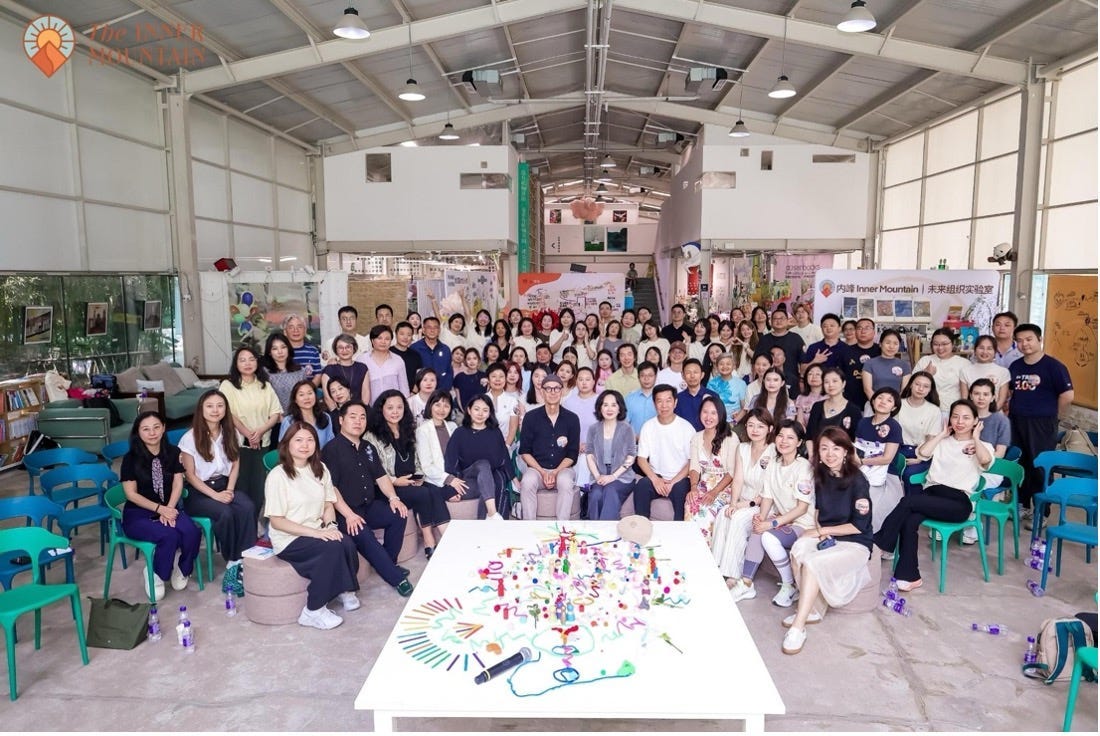
Which brings me back to what touched me during the China week. In the middle of that week, at the Inner Mountain Foundation, I watched fifty members of a core team spend a morning mapping their field through a 3D sculpture practice. The theme that emerged, and kept returning, was a vertical axis: from our planet, Mother Earth, and the trauma we inflicted on her, and through the ancient wisdom traditions and the u-lab methods that translate part of that wisdom into tools for cultivating social soil, up to the current core team and its wider ecosystem with all its dormant potential. As my colleague Lili Xu reflected on that morning: “That one practice in a single morning surfaced a strategic coherence that 100 PowerPoint presentations could never have done.”
Returning: From Seeds to Shoots
Back from a week of reunions at Tsinghua, sculptures at Inner Mountain, conversations with 120 school principals in Shanghai, and the panels at CCC and at NICE — a week that connected me with 3,000 people (including online participants) in various interactive formats — what sense am I returning with?
The geopolitical othering, as mentioned above, broke my heart long ago. What this week gave me was more like medicine. Not because the geopolitics changed — it did not — but because of the social soil that I saw being cultivated in so many contexts.
Here is what begins to clarify. The civilizational regeneration of our planet is not going to descend on us from above — not from either capital or cosmology alone. It grows the way it grew in many of these places that I saw, sensed, and interacted with: container by container, person by person, community by community, step by step.
What makes me hopeful in spite of the current outlook is this: I have seen these remarkable moments and fields of connection not only in China, but also across South East Asia (through our MIT IDEAS Asia Pacific and our Presencing ELP Asia Pacific programs); in South Asia; in Africa through the UbuntuLab Institute; and in Latin America through our ELP LatAm programs over the past five years. In all these places and communities, I’ve seen the seeds that, with the right soil, turn into shoots of profound regeneration and renewal.
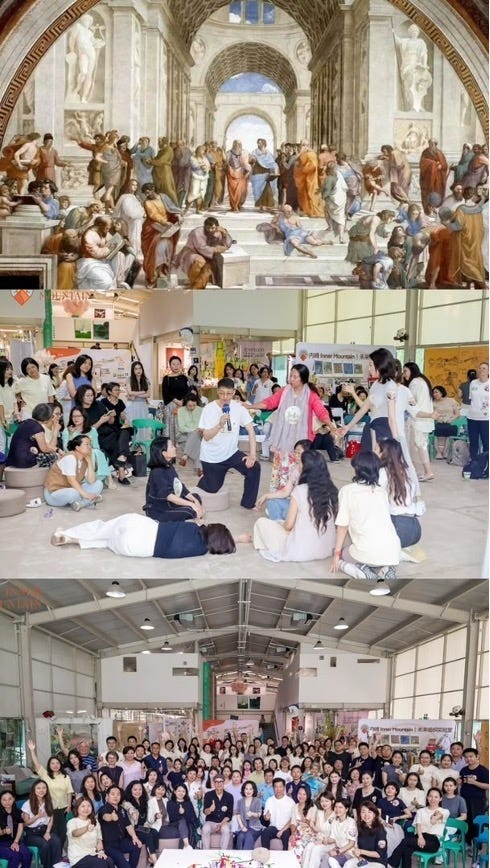
Which reminds me of the 4D mapping in which the person embodying Mother Earth said: “I carry each and all of you in my heart,” while nobody in the entire mapping paid any attention to her.
That’s still our planetary moment. But the shift of awareness is undeniable: it’s a worldwide phenomenon. I saw it throughout the week. I see it in so many places across regions. This new awareness comes into being through bending the beam of our attention back onto ourselves, back onto our relationship to each other, and to our living planet. This is how regeneration begins. This is how the soil opens. This is how seeds turn into shoots. It’s what needs our collective attention now. In China. Here. Wherever you are. Wherever we are, together…
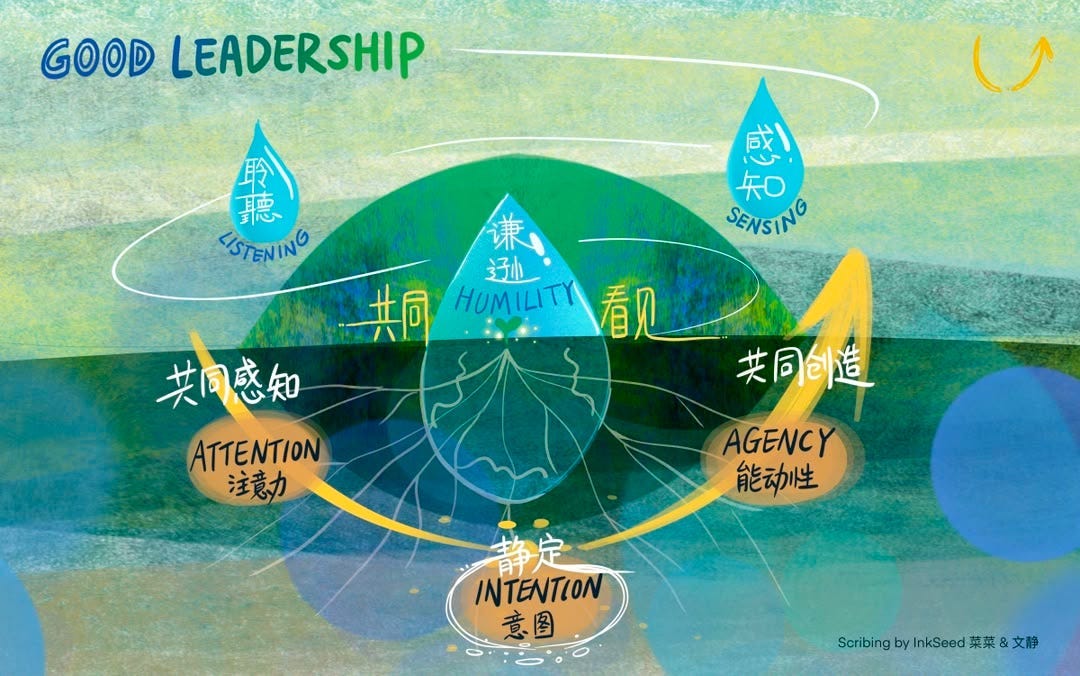
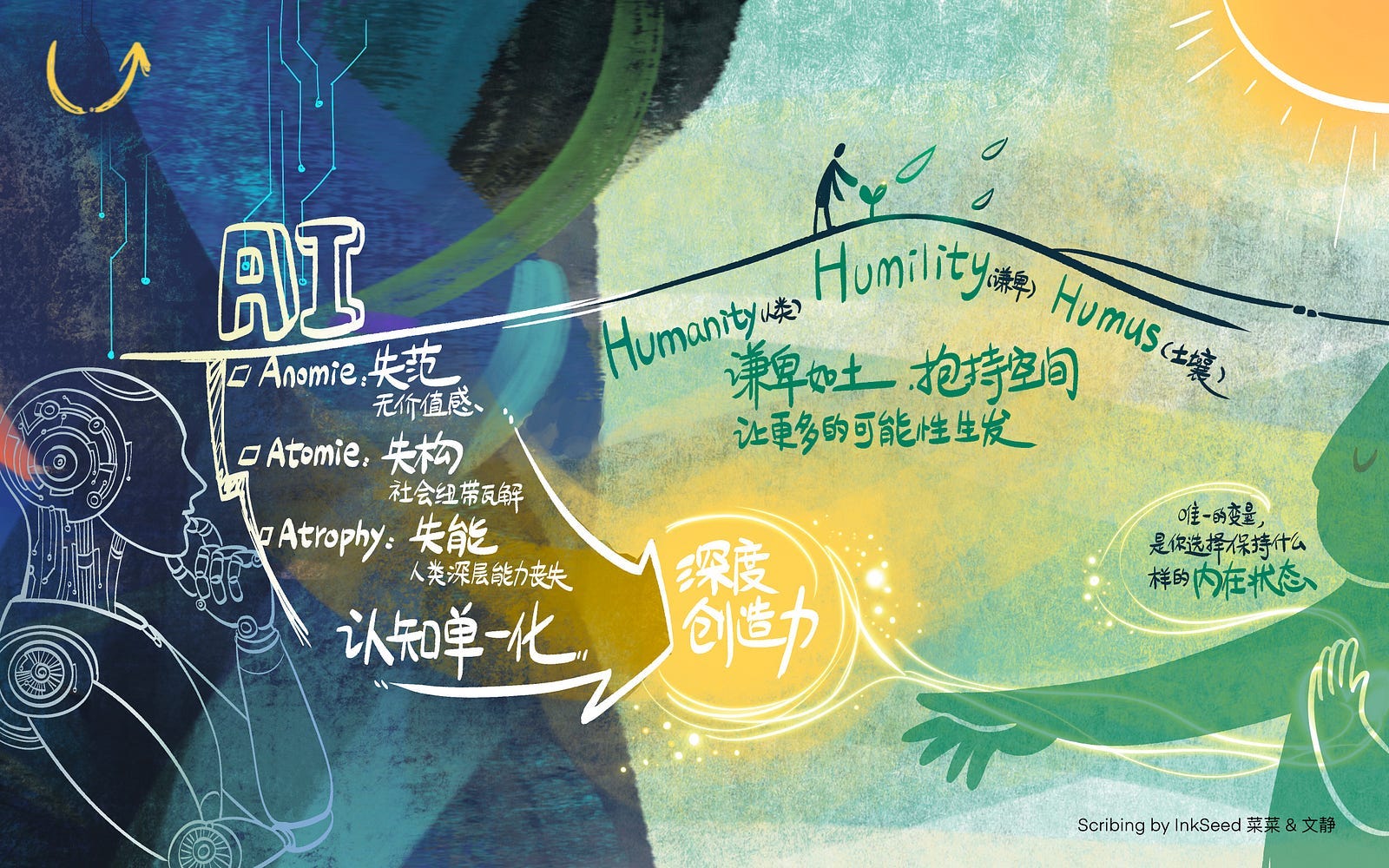
Profound gratitude to the many friends in China and beyond who co-inspired this piece; to Lili Xu, Eva Pomeroy, and Katrin Kaufer for their helpful comments; and to Iris Xia and Jean Wang for their wonderful drawings — figures 1, 3, 4, and 5 as well as the title image atop the post.
For further reading:
Leadership’s Blind Spot in the Age of AI (SMR)
https://sloanreview.mit.edu/article/leaderships-blind-spot-in-the-age-of-ai/
We May Be Entering A Second Axial Age (Noema)
https://www.noemamag.com/we-may-be-entering-a-second-axial-age/
Presencing Institute Research: Social Fields
https://www.presencing.org/u-research
Resources: Homepage
https://ottoscharmer.com/
Including Tsinghua University, NICE, the National Innovation Center for Excellence; the World Foreign Language Academy for the Shanghai school ecosystem, the Inner Mountain Foundation; BeOne; the CCCoaching Center in Shanghai.